Friday, July 15, 2016

Singing City in Johannesburg and Soweto

We arrived in Johannesburg on Friday, July 1, late in the afternoon, and went directly to our hotel on the city's outskirts. The flight was long and tiring but when we arrived at the hotel and found some singers and friends already there waiting for us, we felt revived and settled into a wonderful meal arranged for us by our guides Pieter and Juanita Myburgh. 

On Saturday morning we headed into the center of Johannesburg, South Africa's financial center, for a brief driving tour. The city had a feeling of desolation. People were out and about for weekend shopping - lots of street vendors and large white vans that act as the main mode of transportation for many - but we didn't exit the coach.  We later learned that quite a few South Africans work in Johannesburg Monday-Friday and fly home to towns along the Garden Route or elsewhere in South Africa on the weekends.


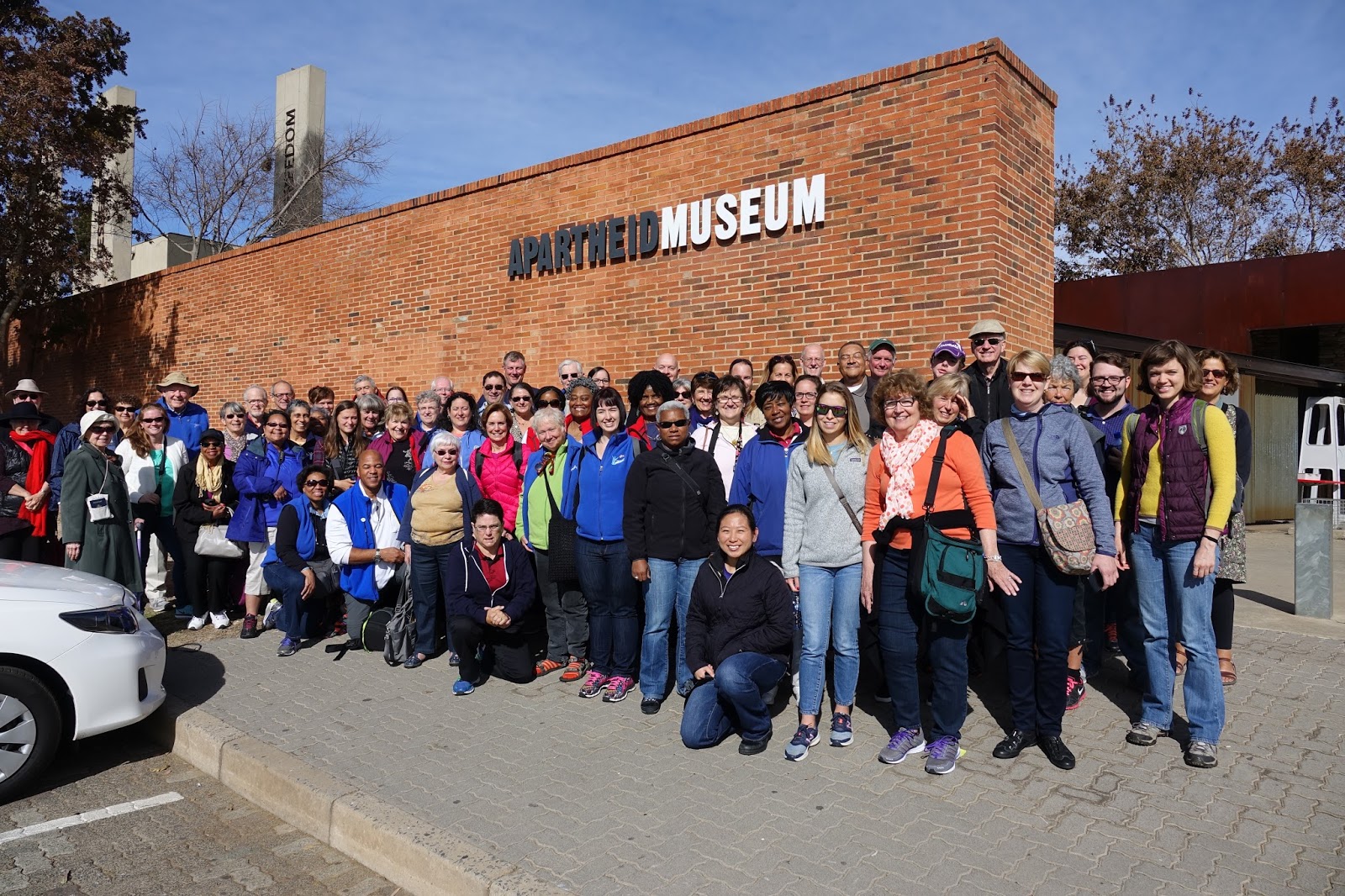
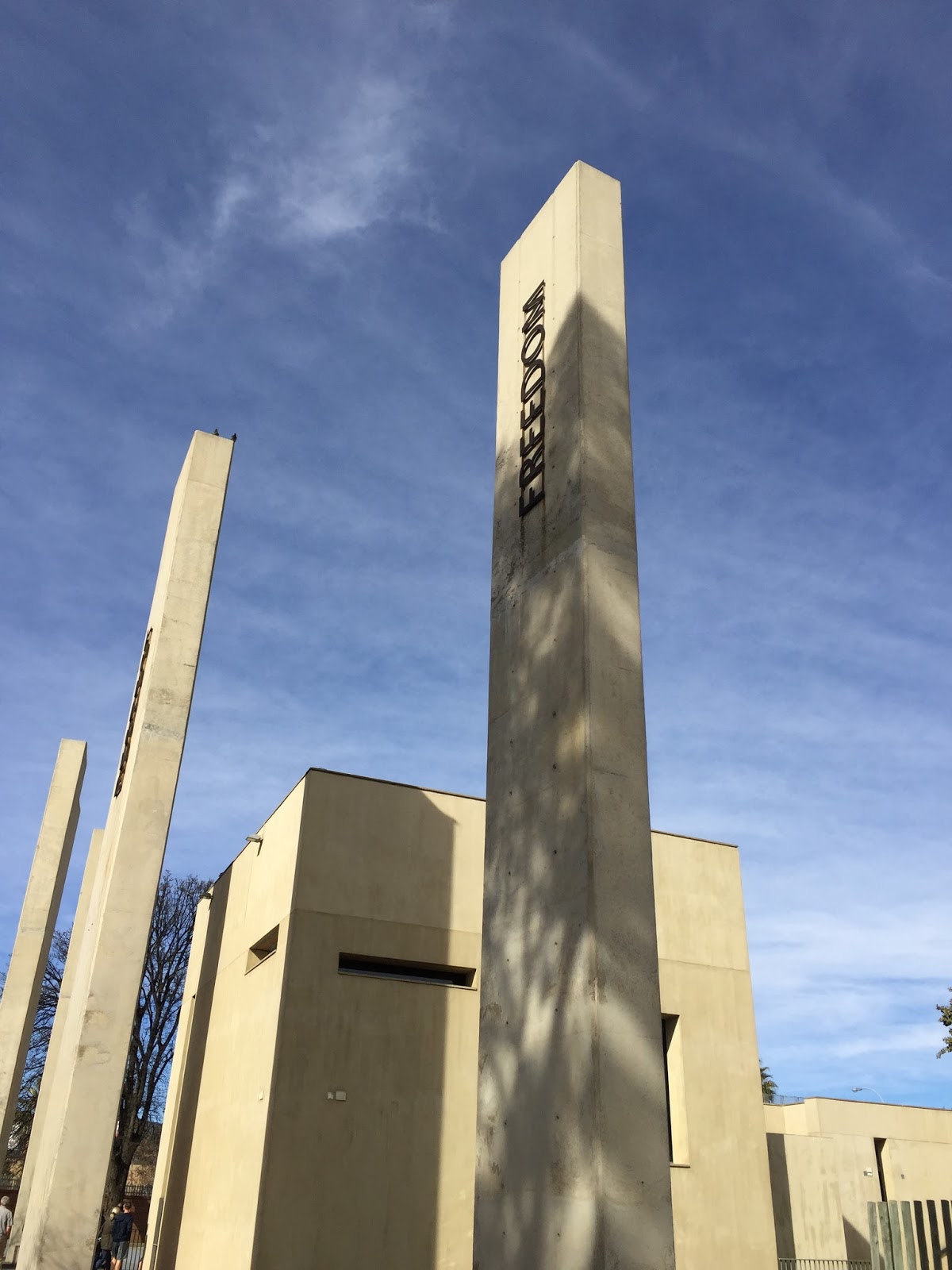
From the center of town, we made our way to the Apartheid Museum. We were immersed in the history of Apartheid and its aftermath, spending several hours making our way through the exhibits. Parallels between our own Civil Rights movement and the Apartheid era in South Africa were brought into focus. Interestingly, when Apartheid ended in 1994, the new government in South Africa brought about far more progressive laws regarding people's freedoms, some that we in the US are still struggling to implement. But while people in South Africa are free to live wherever they choose, they still tend to live along ethnic, racial and economic divisions. Housing shortages are a continuing problem, with new immigrants living along the edges of established communities in tin-roofed shanties. The differences are stark.

It takes at least two hours to make your way through the Apartheid Musuem and, even then, you are just scratching the surface. Apartheid began in 1948, the year that Singing City was founded. Our own beginnings are linked to similar struggles here at home and the Civil Rights movement.  


From there, we enjoyed an afternoon workshop with Mbuso Ndlovu, a Music Director and Choir Conductor, who worked with us on some of the South Africa repertoire we prepared back at home and also taught us something brand new. He marveled at our attempts to choreograph Dubula and did his best to help us move with a bit more grace and style. Here's hoping we can bring him to the US to spend more time with us!


Mbuso Ndlovu


We enjoyed dinner at Carnivore Restaurant, where grilled meats of every description are the focus. It reminded me of our first dinner in Brazil in 2009, a Chiascurria. The meal is served family style with servers bringing skewers of delectable meats one after the other, ranging from boerewors and lamb to ostrich, kudu and crocodile and, for the less adventurous, chicken and beef. Fully sated, we made our way back to the hotel for some rest before a 7 a.m. wake up call the next morning.


On Sunday, July 3, we started the day in Soweto at the Holy Cross Anglican Church where we participated in a church service. Soweto is the most populous black urban residential area in South Africa and was home to Nelson Mandela. Bishop Desmond Tutu's house is just one block away from where Mandela lived. We were welcomed with open arms. By the end of the service, all of us were singing (and dancing) together. Many of those in attendance for church services returned in the afternoon for our joint concert with their choir as well as Soweto Angelic Voices Choir. The church choir is in contention for first place in a local choral competition–very impressive (video below).  It is hard to put into words the sense of community and fellowship that we experienced. It was very moving, joyful, and transcendent. We were bathed in the sounds of their rich, full singing and also shared our voices with them.

At Singing City, we talk often about music's power to open minds and hearts. This experience was proof positive of that. Interestingly, an article by Alex Ross in the July 4 issue of The New Yorker, entitled "The Sound of Hate"  posits that if we agree that music has the power to "soothe the savage breast," we must also recognize that it can be used for darker purposes–inciting violence. Read it here.


We ended the day with dinner at Robby's Place, known as a local shabeen (technically, an "unlicensed establishment or private house selling alcoholic liquor and typically regarded as slightly disreputable"). This may once have been the case, but Robby's Place is a small local, family restaurant in Soweto that served up a delicious spread of comfort food, including Malva Pudding for dessert, a new favorite. Robby was there to greet us, dinner was ready, and we settled in to enjoy the food and each others' company after an exhausting and satisfying day.

 If you are in the neighborhood, it's highly recommended!


Monday, June 27, 2016

Singing City Departs for South Africa on June 30


On Saturday, June 25, Singing City held its final rehearsal before embarking on a two-week tour of South Africa. Sixty-four choir members, friends, and family depart on Thursday, the culmination of two years of planning.


The choir will perform five concerts in four cities–Johannesburg, Cape Town, Mossel Bay and Pilanesberg. While in Johannesburg, the choir will participate in a workshop with local musician Mbuso Ndlovu and give an informal concert at Pam’s Creche, a local daycare center for disadvantaged Sowetan children, as well as perform in a joint concert at Holy Cross Anglican Church in Soweto. From there, the choir will perform with a local church choir in Thembalethu, the black township of George, near Mossel Bay, to be held at the United Reformed Church in George. In Cape Town, the scheduled concert will include local host choirs–Bongweni Adult Choir, Nazareth Youth Choir and Mzamomhle Youth Choir, as well as Singing City. 

This tour marks the 10th for Singing City, the only Philadelphia choir that regularly tours internationally, going back to its its founding in the late 40s. In the ensuing years, the choir has traveled to Israel and Egypt (1970s and 80s), the former Soviet Union (1991), Cuba (2001), Northern Ireland (2004), Brazil (2009), and the Balkans(2012). Singing City made two tours to the South during the Civil Rights movement (1950s), an integrated choir performing during the height of segregation. 

We'll be posting photos and stories about our time in South Africa, so keep an eye on our Facebook page and check the blog from time to time. 


 Brazil, 2009

Monday, March 18, 2013

Announcing Soloists for The Children's March

Soloists for The Children's March, pictured here, l. to r., with Music Director Jeffrey Brillhart, far right, are baritone Ja'Wuan I. Thomas Veal, a junior at Northeast High School; bass Jeung Lee, and mezzo-soprano Madeline Addis, juniors at Germantown Friends School; soprano Marielle Issa, a sophmore at Germantown Friends School; and tenor Andrew Burgmayer, a junior at Radnor High School. Singing City is thrilled to be working with these talented young singers.

The Children's March will be performed on Friday, April 26, 8 p.m. at The Church of the Holy Trinity, Rittenhouse Square, Philadelphia.  Visit our performance page for all the details.


Friday, January 11, 2013

Matthew Emery Winner of 2013 Prize for Young Composers

 Photo by Melissa Mask

Singing City is pleased to announce the winner of the 2013 Prize for Young Composers, Matthew Emery, for his work Voice of Song.
 
Music Director Jeffrey Brillhart notes: "By the end of playing through the second page, it was clear that Voice of Song was something very special. Matthew exquisitely captured the beauty of this poem, by Icelandic poet Steingrimur Thorsteinsson. Harmonically, the work moves from close clusters of sounds out to marvelous, wide sonorities. I was struck too by the beauty of  the individual voice parts. Often, with young composers, one sees soprano lines that are interesting, but supported by often dull inner voice parts. Here, each section gets to soar!"

Matthew writes: I composed Voice of Song in the Spring of 2012. I remember it was after the end of a busy season of finals and year end juries that are often quite stressful for music students. I took immediate inspiration from the evocative poem which is rich with imagery and great lines to set to music. The music begins with one note and from there blossoms as the music opens up into a rich and lush harmonic palate. The piece undulates back and forth, creating tension and moments of relaxation. The music builds to a satisfying high point on the text "Let thy measures ebb and flow / And my soul enraptured go." The undulating music returns shortly after this climactic section, the choir weaves their way to the end of the piece where it finishes in a similar way to how the piece began; with one note softly singing "Come soft voice of song."

Matthew Emery (b. 1991) is a multi award-winning composer. Originally from London, Ontario, he currently lives in Vancouver, British Columbia where he is studying Music Composition with Dr. Stephen Chatman at the University of British Columbia. Emery's choral works have been performed numerous times across North America and have even been heard on CBC Radio 2's "Choral Concert" and have also been broadcasted on live television. His choral works have been performed by all levels of ensembles from school groups, church or community choirs right up to professional vocal ensembles. Matthew has received recent performances by the Canadian Chamber Choir, Vancouver Chamber Choir, University of British Columbia University Singers, University of Louisville-Kentucky Collegiate Chorale and the Nova Scotia Youth Choir. Matthew has choral publications with Alliance Music Publications, GIA Music Publishing and Pavane Publishing.

Singing City will perform the piece at its Winter Concert-A Wonderful World on Saturday, February 23, 2013, 7 p.m., First Baptist Church, 17th & Sansom Streets, Philadelphia. Tickets and information: www.singingcity.org.

Monday, January 7, 2013

In Memoriam - Betty Morrell


 Betty Morrell, center, with fellow singers Wendy Browder, left,
and Aminda Baird, right at the fall 2010 concert.

Singing City lost one of its long-time members on January 1 with the death of Betty A. Morrell, 73, a resident of Meadowood of Worcester, formerly of Horsham, just 5 days shy of her 74th birthday. Born in Passaic, NJ, she was the daughter of the late Richard and Kathyrn (Markle) Morrell. Betty graduated from University of Delaware with a BS in Engineering. Music was a large part of her life. She was a member of  Singing City since the late 60s, performing in hundreds of concerts and traveling with the choir to the Middle East, Russia, Cuba, Northern Ireland, and Brazil. 

Prior to retiring, she worked at Philadelphia Health Management Corp., where she helped establish the Information Technology Dept. Betty stayed active in retirement by becoming involved in many events at Meadowood. She is survived by her two sisters, June Parker and Katherine Pamela de Blecourt, five nephews and a niece. A memorial service was held on Saturday, January 5 at Meadowood.  Many spoke of her love of music throughout her life and her passion for Singing City. She will be greatly missed.


Thursday, January 3, 2013

Singing City at the Philadelphia Museum of Art

 On Sunday, December 30, Singing City performed at the Philadelphia Museum of Art as part of their series of Holiday Events. Under the direction of Jeff Brillhart with Tom Sheehan at the piano, the choir sang works of the season, including selections from Glenn Burleigh's Nguzo Saba Suite; Dave Brubeck's Sleep, Holy Infant, Sleep; Rollo Dilworth's Shine on Me; Israeli folk songs arranged by Bob Chilcott, and more. The Great Stair Hall was festively decorated for the season with beautiful lights shining on the proceedings. The stairs were filled with appreciative audience members.  Photos by Pete Checchia.


Thursday, December 6, 2012

Singing City Remembers Dave Brubeck


The world lost one of its treasures yesterday when jazz legend Dave Brubeck died just one day shy of his 92nd birthday. Singing City's association and friendship with Dave goes back to May 1970, when the choir, with Dave at the piano, gave the premiere performance of The Gates of Justice at the Academy of Music in Philadelphia (photo above). 

To music and jazz lovers, he is remembered for his "distinctive mixture of experimentation and accessibility that won over listeners who had been trained to the sonic dimensions of the three-minute pop single," says Ben Ratliff of the NY Times. He said of himself that he was a composer who happened to play the piano.

He was also a man of strong convictions, refusing to tour in South Africa in 1958, for example, when the contract stipulated that his band should be "all white."  He composed  The Gates of Justice in 1969. He wrote, "The essential message of The Gates of Justice is the brotherhood of man. Because of their long history of suffering, the Jew and Negro know better than any other people the consequences of hate and alienation. It is impossible to concern oneself with the history and tradition of either without feeling overwhelmed by the inequities and injustices which have pervaded all strata of society. The spiritual and emotional ties, born of suffering, which bind these people together, have much to teach all of us on this shrinking planet. It is the strength of such moral fiber that will be our ultimate salvation."

After the premiere, Samuel Singer of the Philadelphia Inquirer said" "But most of all, Brubeck's Gates of Justice, using words thousands of years old from the Old Testament, and quotations from such contemporaries as Dr. Martin Luther King, Jr., and the Beatles, is a work for today, an eloquent plea for justice and brotherhood."


SC Artistic & Music Director Jeff Brillhart remembers: "My first encounter with Dave was in 1989 when he came to Bryn Mawr Presbyterian Church for three performances of La Fiesta de la Posada. I was to meet him late on a Thursday morning, in the church. Excited, I went to the organ to practice what I was to play on Sunday morning, a wonderful work by Bach that all sorts of quick figurations in the hands. Unbeknownst to me, Dave entered the church quietly and settled in at the piano at the opposite end of the church. I neared the end of my Bach and out of nowhere, the piano roared to life, taking Bach's figures and moving into something new-Brubeck meets Bach. Astonished, I got off the bench, turned around and Dave roared! Every encounter with Dave since that first meeting was magical, with many warm conversations, much bawdy humor, and some serious talk as well. We met a giant and that giant changed us!"

Singing City performed Brubeck's Fiesta de la Posada in December 2003. It is a re-telling of the Christmas story with influences of both jazz and Mexican folk tunes. "The ethnic music," wrote Brubeck, "reflects those qualities I most admire in people...dignity in moments of tragedy, infectious high spirits in moments of joy, and an unshakable religious faith made evident in a strong sense of one's own worth and a deep respect for the shared values of one's group - family, church, village.

In May 2007, the choir again performed The Gates of Justice and premiered a  new work, The Commandments, a work rooted in his experiences during WWII. In this archival video from the concert, Brubeck talks about the work.

Dave Brubeck touched many lives. All of us at Singing City will miss him and his passion for life, music, and people everywhere.